


Showing posts with label PBeM. Show all posts
Showing posts with label PBeM. Show all posts
11:31 AM
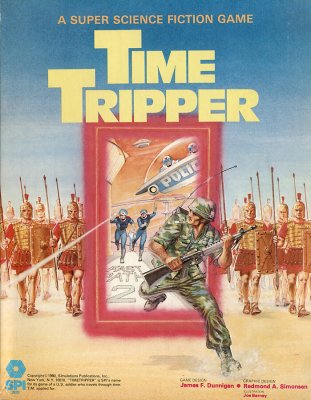
You know, it's gratifying that there are people out there that cherish the old ways. I was on Boardgamegeek recently (back up after being inexplicably down for a week) and was catching up on some old geekmail. One of these was a comment from the designer of the old Avalon Hill game WIZARDS. I actually don't own that game, nor ever played the physical game, because, well, it kind of came and went when I was a youngster-- I never saw it in a store. But I love tile based games like this (and the far more complex MAGIC REALM), so I have downloaded and played the Java implementation of Wizards on the dewkid website. It's a fun pastime, not anything that floats my boat like Colossus does, but it retains the game play and funky artwork of the original nicely, and so it's a nice diversion. I hadn't looked at that site in eons, and the geekmail reminded me of it again.. so I popped over, and upon browsing the site for updates, noticed that Robin had made a java app based on the old SPI Time Tripper game. Now this was a development that brought back a flood of nostalgia. I had owned Time Tripper once-- and played it, regularly. I inflicted this one on my friends many times. We all liked the premise of the time-tripping Vietnam squaddies encountering hordes of generic bad guys from various realms of history and fantasy. A great game, and a great idea for a java implementation. I have to hand it to people like Robin, they really are the salt of the earth, making stuff like this available for free. Well done!

1:55 PM

I haven't been keeping up with a lot of the PBeM via JAR stuff that's been en vogue lately, for at least a couple years. Although I had heard of WARGAMEROOM.COM, I hadn't really tried that service out yet. Dunno how I found this out, but it turns out WargameRoom makes a module for my recently acquired 1960: THE MAKING OF THE PRESIDENT. Wargameroom.com seems to favor supporting card driven area movement conflict simulations, such as Paths to Glory. The interface seems less splashy than cyberboard or aide de camp II, but who cares, it gets the job done.
That being said, I'd love to try out 1960: THE MAKING OF A PRESIDENT with a patient opponent some day.
10:18 AM
Total Gaming Geek Reference...
For the unititated, Cyberboard is a PBeM tool that the creator, Dale Larson, gives away for all intents and purposes. Aide De Camp is a PBeM tool that the creator, HPS Simulations, sells as a commercial product.

Maybe it's not "Shecky Green" funny, but if you have ever played a play-by-email game... oh, the lols! (the poor spelling serves only to heighten the experience for me, you might say)
11:49 AM
Various Games posted here
Nanofic: I don't feel like killing this, and have found the requisite files on the requisite datastick to resurrect. Need to have some idea of what everyone's last turn was, however. Contact me, Otto, JR, Allan and Jason.
(apologies for the stall-- my day job is a bitch...)
BPD: A new game starts this week! The categories will be historical subjects! Email me at hussar (at) hotmail (dot) com if you have an interest.
Zendo: Do you have the Buddha nature? I'm think of starting a relaxed session of this excellent logic game by Looney Labs shortly. I've discovered a great new PBW site called SUPERDUPERGAMES that runs versions of Zendo using the classic pyramids, but also with numbers and words. I prefer the pyramids, myself. I'm not sure if a game could be started on there and just run by me, the other people interested in playing may need to register, too. Realistically three weeks to a month out, as I need to play a game on their site to see how it works. Zendo is entirely dependent on how rigorous the demands of COLD WARS are, however.

References:
http://superdupergames.org/ (website)
http://wiki.superdupergames.org/games/zen (SD's Zendo Wikki, with their house rules)
http://www.wunderland.com/icehouse/Zendo/ (Zendo Home page)
http://www.wunderland.com/WTS/Kory/Games/Zendo/HowToPlay.html (Original Zendo Rules by LL)
http://www.sholing.force9.co.uk/bypop.htm (*BPD RULES*)
http://mrnizz.blogspot.com/2006/10/nanofictionary-by-email.html (NanoFIC via PBeM)
12:40 PM
Ready to try Nanofic out
.. as of Monday
Please post the email you wish to have your "hand" notice sent to.
Table Locations (see the graphic for what this means)
NW Player: Otto Schmidt
NE Player: Allan Rothberg
SW Player: J.R. Tracy
SE Player: Jason Schmidt
I will send a hand to all of you this weekend. You may choose ONE card for initial placement on the "Game Table" and I will post the table picture for all to see after that.
Judges:
You shouldn't have to do anything, but contact me via IM or email to get the home page I plan to post the polling applet to. All you have to do is to vote 1-10 on stories as they get posted.
I have the following people as judges:
Gary Christiansen
Charles Vassey
Matt Foster
Ian Wedge
I'll handle all the coding and cyberboard stuff.
12:29 PM
A Modest Proposal
I love storytelling, and I love games, so you would think that storytelling games are a natural. I find that they are a hard sell to any gaming group, because, frankly, many gamers are shy and don't like being "out there" in front of a group, telling stories. So the following proposal is my attempt at bringing one of my favorite storytelling games to the realm of email.
PLAYING NANOFICTIONARY BY EMAIL OR ONLINE: FOUR PLAYER INSTRUCTIONS
Original Rules by Andy Looney
PBeM Revision by Walt O'Hara
Using Cyberboard for email games and/or VASSAL for real time games (eventually).
NANOFICTIONARY is a game of telling tiny stories published by the good folks at LOONEY LABS. Cyberboard is a free Windows based utility that can facilitate playing games by email.
References:
Nanofictionary- http://www.boardgamegeek.com/game/2895
Cyberboard- http://cyberboard.brainiac.com
This Cyberboard gamebox and these instructions are provided as a free service to facilitate story telling games over the medium of email with a little help
from the web.
DISCLAIMER: NANOFICTIONARY remains the copyright and intellectual property of Looney Labs. It is assumed that the player(s) own an actual, physical copy of Nanofictionary before using and downloading this utility. This utility does not copy any of the artwork of the original game (beyond the logo) and you are depriving yourself of half the fun of the game without the real cards. See your local hobby shop, online retailer or go to http://www.looneylabs.com/OurStores/LooneyLabs.html to purchase a game. Nanofictionary is quite reasonably priced.
What is needed:
Four players (will expand to six if this approach playtests well)
Four Judges
A Cyberboard Savvy Referee
Someplace to post results and manage voting (like a blog or bulletin board)
Nanofictionary is primarily a story telling and judging game that uses a nice little card deck to facilitate common story telling elements (called Plot Devices) in the following five card categories:
ACTIONS: a meta-card that affects card play (purple)
and four types of color themed PLOT DEVICE CARDS:
CHARACTERS: A perons or persons that have a role in the story being told (green)
PROBLEMS: A complication to the current plot adding more depth to the plotline (orange)
SETTINGS: A place that has some impact on the story (blue)
RESOLUTION: A card that can end the story (yellow)
The rules to Nanofictionary are here: http://www.wunderland.com/LooneyLabs/Nanofictionary/Rules.html
Email Nanofictionary works pretty much like that for card handling and story writing, only the game will be refereed by a gamemaster (who might also play or judge) who will use Cyberboard to deal out cards and assign cards to players. MOST of the game will be handled with simple email notifications of what card players will be adding to their storytelling decks. The Judging phase might make use of some form of collaborative web technology to judge with. Scoring will be handled with a slight modification of the printed rules.
SEQUENCE:
1) CARD PHASE
The GM uses Cyberboard to "Deal" (pull five cards out of the .Draw Deck) for each of the players. The .Draw Deck is set to produce random pieces when tiles are dragged out of the "tray" in Cyberboard. The "random drag" feature of Cyberboard simulates a card deck reasonably well, as it was meant to do.
The players are sent an email of the cards they start with. Chances are they will *not* have enough cards to write a story immediately, as Nanofictionary states that You may have as many Characters in your story as you want; however, your story can only have one Problem, one Setting, and one Resolution. EXCEPTION: if the player states that a COMPLICATION Action Card (Purple) is being played. If that is played, then a second Problem, Setting, OR Resolution may be added from their hand.
Before the FIRST TURN ONLY, the players state what STORY ELEMENT CARD (green, blue, yellow, orange only, no purple) they wish to start their story with. As Cyberboard maintains a "map" graphic with tile overlays to represent pieces, the referee can send the players a picture of the "card table" graphic in Cyberboard, to illustrate what cards are in play at the start of the turn.

Figure 1: The Game Table as Depicted in Cyberboard
During the Card Phase, the players must email the GM that they are going to do one of the following:
1.) Add a Plot Device (Character, Setting, Problem, or Resolution) to your story, specifying WHICH of the cards in their hand they will add. Note that the plot devices you add to the story will be communicated to the other players UNLESS it is a RESOLUTION (yellow) card. That is always played "face down" in real NanoFic, and will not be revealed in email NanoFic.
Here is an example of a Character Card, a Problem Card and a Resolution Card:


2.) Use an Action card by discarding it and following its instructions
See Action Cards, below.
3.) Discard as many cards as you wish, and draw back to 5
ACTION CARDS in the PBeM game

Complication: Adds a second Setting, Problem, or Resolution to your Story from your current hand, then draw one card from the .Draw deck. Specify in email which card you wish to play.
Brainstorm: All active players draw a card from the .Draw, then give a card of their choice to you. You also draw an extra card for each inactive player. Then you play one card, and discard down to 5. The GM draws from the .Draw deck for each player and lets them know what it is via email. The player specifies which of their cards they will donate (by email) to the GM. The player using Brainstorm (there are only two in the game, btw) emails the GM which cards will go to the Discard deck.
Plagiarize: Steal a plot device from another player's story, by swapping it with a card from your hand that is of the same type. The Purple Action card is "played" by sending the GM an email saying "I am swapping my card X for player n card's Y". The card gets sent to the Discard bin, its job is done.
Uncrumple: Take any card out of the discard pile (except action cards), add it to your hand, then play one card. The Action card is discarded and the new (old) story element is back in your hand. The contents of the Discard pile are sent at the beginning of the turn. If you something you desire gets discarded in the current turn, you will simply have to pay attention.
Thus ends the CARD PHASE.
2. The WRITING PHASE
If the player has the minimal elements for a story in Nanofic terms (at least one character and only one setting, problem, and resolution per story), he/she might elect to "do a tell" (put together a story and allow the other players to hear/see it).
If we were all playing face to face (my favorite way of playing Nanofic), this would be done in the grand old style of the oral tradition. Alas, the Internet can't provide that sensation (yet?) and we can only weakly imitate with the written word. Given the restrictions of the written word, this is the Player's chance to excel. Nanofic's definition of a nanofiction is any story that encompasses every story element that has come into play for the player. Telling a NanoFic story is something more than writing a long run on sentence that mentions every term written on the cards. HUMANS read and score your NanoFic for this very reason.
This instruction can't tell you how to be creative; that part is up to you. Try to make stories brief (this IS *NanoFictionary* after all), approximately a para or two long (and not a long paragraph). Submit stories to the GM in text format, with Line Feeds and very basic formatting. The stories will be posted to a central point of access (a website, blog, bulletin board, etc.) so, please use some common sense about the content, as your name attachs to it.
Guidelines for writing are loose and easy-- as long as the judges can recognize the story elements you were dealt, you can make some contextual changes. You may change sex from male to female if you like, or plurals to singular and/or back again. Follow the guidelines that Andy Looney wrote for creating nanofictions, they still apply to the email game. Think of writing NanoFic as creating a Mad Lib in reverse. In Mad Libs, you are given the structure and asked to fill in variable terms. In NanoFic, you are given some specific terms and are asked to create the surrounding structure!
Examples taken from Figure 1:
North-West Player: "A Team of Super Scientists were plagued by terrible weather fluctuations all over the West Coast. By their prediction, a terrible super-storm was imminent and they had to come up with a solution, pronto! Just as things looked hopeless, their corrupt lab assistant, Benito, tipped them off about a weather-changing mcguffin that was stored in the Bus Depot, near locker 17. When they manged to jimmy the locker open, all they found were several plastic baggies filled with a strange white powder. Despite their strenuous objections, they each spent two years in jail for possession with intent to distribute. The irony was lost on them."
North-East Player: "The Bleary Eyed Waitress, Flo, went to the World's Fair in a vain attempt to lift her spirits. Each bright and shiny innovation on display at the Fair was a poignant reminder of stuff she would never own or a home she would never live in. Suddenly Flo's depressed reverie was shattered by screams! Up in the Sky loomed a menacing Circular object.. an Alien transport ship! A Hush fell over the crowd as the unseen speakers on the outside of the alien craft emitted: "PEOPLE OF EARTH-- WE ARE YOUR NEW MASTERS. WE HAVE COME A LONG WAY TO RIGHT AN INPONDERABLE WRONG! WE HAVE ARRIVED TO DISCOVER ... WHO STOLE MY BROWNIESSSSSSS????". No answer was forthcoming from the crowd, so a villainous death ray lashed over the planet, and the Earth was destroyed".
3. The JUDGING PHASE
If the GM is web-savvy, he will have set up a polling application on a website somewhere, facilitating voting for the current NanoFics. At the bare minimum try to have as many judge volunteers as you have players. Each judge reads the NanoFics for every submission, and gives it a score of 1 through 10. This is communicated to the GM in secret by each judge.
SCORING
Read this part carefully, as the Nanofictionary scoring system is somewhat different to streamline the process for email play.
Stories are scored in the following fashion:
Games are played in ROUNDS. The Game ENDS when the .Draw deck is empty.
A ROUND is complete once all four players submit stories. A player gets a COMPLETION BONUS AWARD for the order in which they complete their stories.
This is a Completion Bonus Marker in the Cyberboard gamebox:

There is a Completion Bonus Marker in the gamebox (1-6 for a maximum of six players, you only use as many as you have players). They are awarded in descending order, thus, the first person to submit a story receives the #4 Completion Bonus (and Four Points). The second person to submit a story gets the #3 completion Bonus (and Three points, etc.).
The first points a player gets is a completion bonus, per round. 4, 3, 2 or 1 points. More with more players.
Next, average the scores given by the (at least 4) judges. Add that to the player's score.
Next, add points for Action Cards played, per this table:
0 points per extra CHARACTER CARDS
1 point per extra PROBLEM CARD
2 points per extra SETTING CARD
3 points per extra RESOLUTION CARD
Total these points. In the unlikely event of a tie, dice off or flip a coin. Award First, Second and Third Awards per ROUND.
A Round Award looks like this:

FINAL GAME SCORE: Total Round Awards, as per this schedule
For every first place ROUND AWARD: 10 points
For every second place ROUND AWARD: 7 points
For every third place ROUND AWARD: 5 points
HIGHEST SCORE AT GAME END WINS THE GAME
12:51 PM
A freebie from Mister Nizz
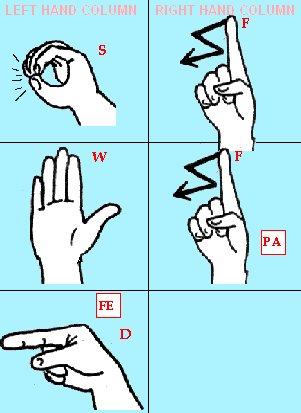
One of the greatest old pen and pencil games I can think of is Richard Bartle's WAVING HANDS (1977) a game originally setup to play as a wizardly dueling game. Players BUILD spells with various hand gestures such as SNAP, WAVE, POINT, CLAP,etc. The combinations (both hands handled separately unless they are CLAPping) create spells. In the graphic to the left the BLUE wizard has just succesfully completed casting FEAR with one hand and is almost done with PARALYSIS with his other hand (check the combinations in the rules!).
The hard part is guessing what your opponent is going to do and making the correct accomodations on your end. For instance, if you see a FIREBALL combination building up it might be time to cast a PROTECTION FROM FIRE. I have played it many times-- the game itself (rules, etc.) is found HERE in its original text.
You can play the game semi-interactively with several other people as WARLOCKS on Ravenblack.net, or via email on the FIRETOP MOUNTAIN server. Both are a hoot.
I'm trying something different, by tinkering a little. I used Cyberboard to create a PBeM "gamebox" for Waving Hands that has a crucial difference from the original. The original Waving Hands takes place in "no space".. or a logcial construct where there is no distance between magic users and no relation to a physical plane of existance. That's certainly a workable, fun and interesting game. Just for grins, I added graphical representations to demonstrate the wizards and their summoned creatures fighting on a physical place (a dungeon, in this instance). This adds an element of MOVEMENT to the game that wasn't there before.
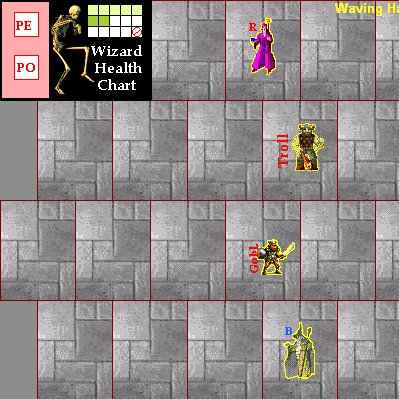
This gamebox provides all you'll need to play WAVING HANDS/WARLOCK/SPELLBINDER via cyberboard. A Gamebox, Scenario and "WizardlyDuel" starter Game File are included. There are also amended rules for Play By Email and movement (my changes are in blue) stored in an HTM file. THe original is also provided as a word document. I've played around with it and it's a hoot.
So here's the Gamebox File, enjoy yourselves.
4:26 PM

Allan Varney checks in at the ESCAPIST
Varney, the designer of GLOBBO and Illuminati: Mind Freeze (aka Illuminati expansion set 3) wrote a nice general survey article about the problem of the lack of human players in your home town and how the internet is providing technology to counter the problems of physical separation.
Most of the article is a survey of available PBEM utilities and programs (such as Cyberboard, ADC2, and Vassal), most of which I already knew about. I thought it was a pretty good article but incredibly pessimistic about paper based wargaming, which I absolutely disagree with Mr. Varney on. I'm a little ticked about the "Elite" attitude demonstrated by console and PC programmers towards our hobby. check this out:
It would take a miracle to pull the wargame community back from imminent oblivion. But you know, military history is full of unlikely last-ditch victories. Wargamers should try for one of their own.
With all due respect to Allan V., whose work I enjoy (especially Paranoia).. maybe he should have done some homework (over on CONSIMWORLD) before letting fly like this broadside. The very hobby he is issuing a postmortem for in this article has been greatly reinvigorated by the advent of the Internet technologies described in detail therein. It's certainly true that we aren't enjoying a cornucopia of new releases these days, but respectable companies such as GMT and Avalanche are pulling of 2 or 3 products a quarter, and that's nothing to sneeze at.
I remember the days of SPI and AH (naturally), and people seem to forget that with all the gems being made in those days, there were PLENTY of turkeys...


