


10:24 PM
BPD "Wuerthy" draws to a close...
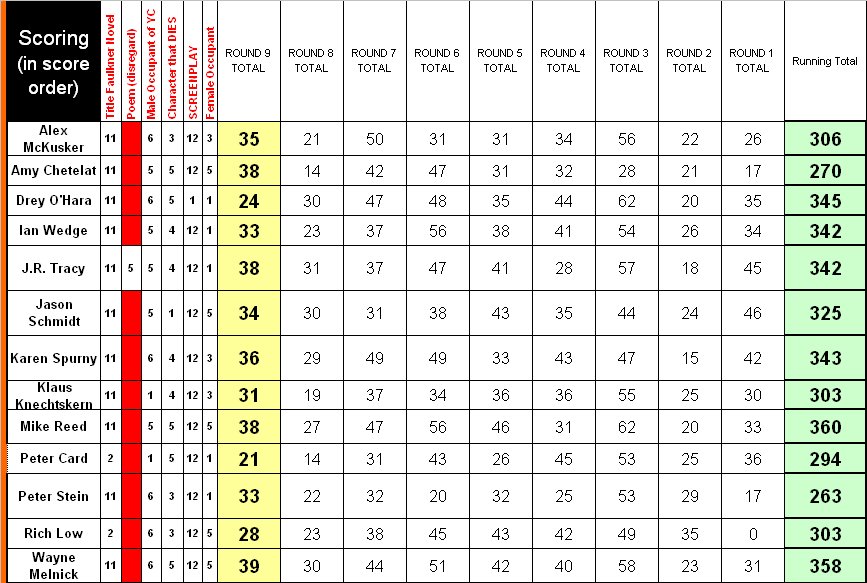
Congrats to Mike Reed who scored consistently well, and my own beloved, who points out that sleeping with the judge gave her NO advantage except that warm and loving feeling, and to J.R. in third place who had a really good last four rounds.
Rich Low did pretty good for a guy who jumped in after a scoreless round 1..
Sorry, Jason, I wanted to end it and get on to NanoFict. I couldn't wait forever.

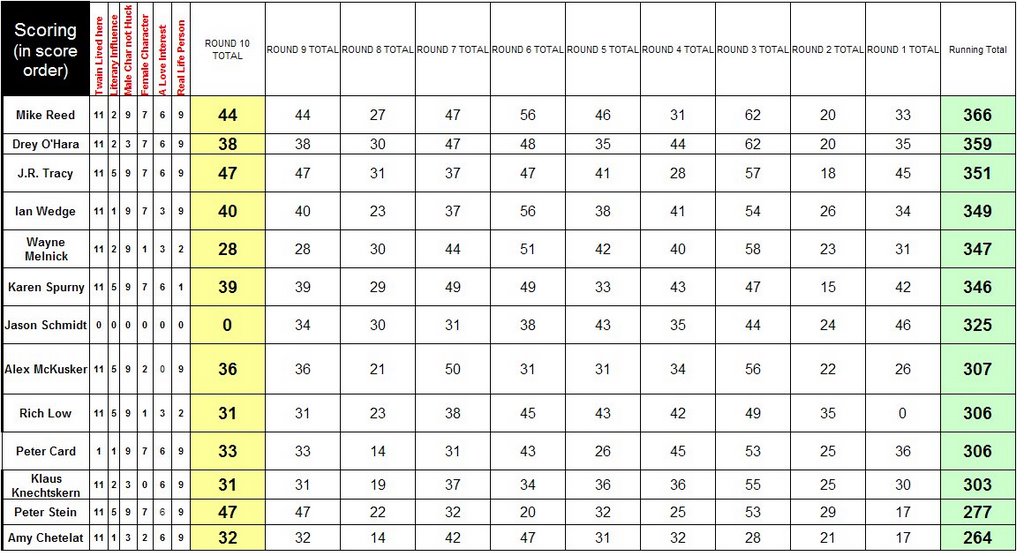
NOTES:
The Oprah round was an anomaly... it was a great topic because of all the possible choices and ready availability of information on the books. I just haven't read a lot of chick-lit except for THE LOVELY BONES and THE RED TENT.
(You can blame Audrey for the Oprah and Doctor Seuss rounds, btw).
As for the rest, I've read at least one or two titles in every round, and some of them (like Burroughs, Seuss, Lovecraft and Vonegutt) featured authors that I've read extensively. The other choices were inspired by the common experience with Freshman Lit that I suspect we all share. Well, maybe except for Klaus.
Since this blog now features subject tags for sorting of posts, it's relatively easy to see the entire progression of the game, thusly:
http://mrnizz.blogspot.com/search/label/BPD
Thanks for playing, everyone, that was the best game of BPD yet. Hope I didn't get too obnoxious.
I'll run another in about two weeks. We are almost at the point where we can judge some stories in NanoFict and I would like to get that going.
Congratulations to Mike Reed, our Wuerthy Winner!
12:52 AM
The hobby of a gentleman of leisure...
Check out William Terra's 1/20 scale model (with engines!) of the German Graf Spee battleship.

Suddenly, vast vistas of naval wargaming are opening up in my mind..

Jutland, at this scale, would need one of the great lakes...?

Yes, it's even powered...

This model shows some amazing detail...

Check out the original site..a>
10:55 PM
God Bless Us, Every One!
Just like last year and most years, I am working the stocking stuffer "little presents" approach for my kids. They have a pretty warped sense of humor, the little tykes. Lord knows where they get it from. So I have to put a little thought into the kinds of things that will appeal to them.
One again, my favorite source of supply is the fantabulous purveyor of weird things on the West Coast, ARCHIE MCPHEE of Seattle, Washington. I assure you, they are very much worth a browse on their ONLINE CATALOGUE, this time of year. You will be inspired.
For starters, a little sweet...
For both kids, a little reminder that home is where the heart is.. an anatomical gummy heart. Mmmmmm yummy, kids!

Ponder the moral implications of cannibalism as you chomp on this thick and chewy gummy heart. Each 4" tall, 90 gram hunk of gummy candy is realistically detailed to look just like the vital organ that is beating in your chest right now!
For Anne: Seven deadly sins Wristbands..
Those rubber bracelets are all the rage at the moment, why not convey a message of salvation?

It started with yellow wristbands before moving on to every color of the rainbow and every cause under the sun. That's great for positive, constructive people, but what about the cynics and smart alecks? Where are their wristbands? Each of theses Seven deadly sins Wristbands celebrates a human weakness. Whether you enjoy gluttony, greed or plain old lust, just slip on one of these rubber wristbands and show off your fatal flaw. Fits most adult wrists
And Gar, the little carnivore, will enjoy MEAT LOVERS wristbands, I can tell..

I personally liked the new Carnival Freak Show action play set... I may pick up a few of these, ostensibly for the kids...


Last year I got Anne a Barista action figure, this year I think she needs an Albino Bowler.

And Gar got a Blackbeard the Pirate figure last year, so I think getting him CARL JUNG is absolutely neccesary this year.

He's also on a pirate kick, and so he NEEDS a what would a pirate do? spinning folder...

Finally, Annie has a spiritual side, and I often remind her that if he she doesn't study hard in school, she will need to learn how to say "You want fries with that?" So what better present than SAINT MARTHA: PATRON SAINT OF WAITERS AND WAITRESSES?

As for me, Mcphee let me down last year and ran out of Mexican Wrestling masks (the perfect spice for the bedroom, of course!) so I'm ordering two sets..

Another fine Mcphee Christmas!!!
6:50 AM
Fun with Audio
It's been a while since I checked with AT&T lab's text-to-voice projec called NATURAL VOICES, and I can see they have made progress. The results are far less robotic sounding-- I look forward to the day when this engine can be used as a plugin for typed speech as a blogging tool-- sort of a "click here to listen to this post" kind of thing.
In the meantime, here's the LAST post about lunch in a converted bar from my youth, converted to audio. Since the tool only converts 500 characters at a time, it's broken up into different audio bits with different voices.
Part 1: The "Crystal" voice
Part 2: The "Mike" voice
Part 3: The "Rich" voice
Part 4: The "Lauren" voice
Part 5: back to "Mike"
11:57 PM
The More Things Change, er.... The More Things Change
I ate lunch at the only place I could find handy today, on my first day of work at the new job site-- McDonalds. Not my first choice, but there's no diner handy. Anyhow, as I was rapidly consuming my rather bland lunch faire... it occurred to me, I had been in this spot before.

This was the spot where SKYLINERS, a grubby pool hall/bar combination, used to be. I had no idea when this conversion took place, but the room's layout was essentially the same from days gone by. The picture above was where the bar was located...
Mind you, none of the pastels and nauseatingly bright tile was in evidence back in the day. This was where a row of rather dingy booths were.. we used to repair here after movie shoots, I remember it well.

I mentally cringed at the lame attempt at faux art deco fifties crap...
And here were the pool tables. Back in 86 I was struck across the back of the head and shoulders by a pool cue in a regretable incident. Today's it's the kid's play area. Funny, huh?

Don't get me wrong, I'm not waxing nostalgic here. It was just a bar, and bars come and go. I've been in better establishments. I am merely musing on the how I recognized where I was by the pattern of the surroundings, it was almost eerie.
6:07 AM
Big Changes
I'm going to my first day of work at the new job today. For those of you who know me, my Navy.mil address does not work any more. I know work for a DOD organization. I have no idea what my new email addy will be or when it will be online, or what my level of connectivity will be. I DO know that the daily tempo will be pretty intense as I get settled in, so you may see posts slow down a bit until I get used to things.
On the bright side, they don't have a problem with me having a laptop so I can check my home email (hotspur...) from there at lunch time.
12:02 AM
My Artillery Park
My Red Army now has some early artillery pieces to decimate the Whites, Poles and despicable capitalist tools with..

That's the Russian 76mm Putilov field gun, by all accounts a really good field piece.
Here's a historical photo:

The model doesn't seem as if it is to scale.
The smaller gun is the French 75mm direct fire piece.

That DOES appear to be in scale..
10:56 PM
and I know I do, check out ROCK, PAPER, SADDAM!
click on the picture to procede.

click on the picture to procede.
10:05 PM
P R E Z C O N will be with us shortly
The Prezcon folks are big supporters of TriaDCon, and we intend to return the favor!

Fellow Gamers:
It’s time to Register for PrezCon 2007 – February 21 – 25 at the Doubletree Hotel in Charlottesville, Virginia.. This is our 14th “Winter Nationals” The PrezCon Flyer will be in the mail to them Dec 4th, including all the latest PrezCon info.
PrezCon 2007 will have three Advanced Events, over 80 Tournament Games in seven tracks, as well as special “conventions-within-PrezCon,” including RevCon, The Settlers of Catan Regional Championship, the Titan National Tournament (TNT), and, of course, RonCon (the late-night Con for those who must game all night.) See the Event Summary link at PrezCon.com for a listing of tournaments. Use the My Schedule link to make your own printable schedule!
We look to have a great Con with more players, new games, and more game designers/developers. PrezCon offers all this in a fun, interactive, friendly, and competitive environment. In addition to Tournaments, there are game demos, open gaming, the best game exhibitors, an outstanding Auction; and convenient, wholesome and inexpensive gamer-type food and cold drinks!
Now is a great time to Register On-Line so you won’t miss out on any of the fun, save some money and you get a neat PrezCon shirt or hat.
PrezCon encourages Gamers and Game Masters to “talk up” PrezCon and their events wherever they are, on ConsimWorld, at gatherings of gamers, other conventions, etc. Your “personal invitations” to PrezCon is the most effective means of introducing gamers to our convention.
The On-Line Registration process is simple, the result complete, and you’ll be ready for the February Winter Nationals. Go to www.prezcon.com, click on the Registrations link on the left-side of the page, click Player Registration. A little thinking about choices, a few fast decisions, and You’re Done – All Set!. (And don’t forget to tell your friends….)
Best regards,
Bill Alderman
Vice President
PrezCon, Inc.
3:16 PM
To all my (celebrating) friends out there, and there are many of you!
Happy Thanksgiving!

(notice the qualifier? Diversity is in...)
Happy Thanksgiving!
(notice the qualifier? Diversity is in...)
1:33 AM
Wowsers
I love stuff like this, even though I haven't played a roleplaying game in ages. There's got to be an application for this somewhere...

Wizards put a news item up about somebody putting together a Java implementation of their dungeon mapper tiles that just got released. It looks fantastic. You can find it here:
http://jai.hordelings.com/DungeonTiles/
Have fun!
1:22 AM
Sayanora, Rick
I just read the announcement from Rick Thornquist, the editor of BOARDGAMING NEWS, that he will no longer be at the helm of that site as a general editor, and will be stepping down immediately:
I have come to the decision I’m going to retire from the game news business.
Why? Well, there are quite a few reasons. One major one is that I’ve been doing it for almost five years now and I feel I’ve done everything that I can do on the boardgaming news front. There are a number of personal reasons as well.
Note that this is different from my decision to leave Gamefest. With Gamefest I was dissatisfied with Gamefest itself, but still keen on doing the job. With this I’ve decided to leave the job altogether.
What does this mean for Boardgame News? Well, much to my surprise and delight, someone has stepped forward and volunteered to take over the reins of the site and that someone is Eric Martin. This is great news - I didn’t want the site to disappear and Eric is eminently qualified to take over. I will be handing over everything to Eric today - Sunday, November 19th.
Personally, I will be relinquishing my weekly column and will now contribute as an ‘at large’ columnist. I may do some other things, but that will be up to the discretion of the new editor.
(comments copyright Rick Thornquist)
That's really too bad. I'm seeing a general decline in the concept of sponsor supported gaming news and commentary sites-- I think the Games Journal was the last to go, and now this (although BN will continue under new management). I wonder if its a simple economic problem. "Gaming Journalist" always struck me as kind of a dream job in some respects, jetting off to Essen, the Chicago Toy Fair, Las Vegas for the GAMA trade show, etc.. Maybe it's not all its cracked up to be. It's hard to fathom making more than a nickel and a dime doing it, so the love has got to be there first-- if you can't make that happen, you might as well give it up.
9:19 PM
Someone passed me an interesting article from the NEW YORK MAGAZINE by Niall Fersuson. Some interesting conclusions here, but I get the feeling the author needed to do his homework about grand strategy games.
How to Win a War
With a nuclear North Korea and Iran on the way, the geopolitical situation is evolving in unpredictable ways. Can a hypersophisticated World War II simulation teach us 21st-century global strategy? An eminent historian rates the state of play.
By Niall Ferguson
All my life I have played va banque [go for broke],” said Hitler. Churchill too was a gambler, once literally deluging his wife with his casino winnings. Eisenhower preferred the bridge table. For Homo ludens (“playing man,” a phrase coined by the Dutch historian Johan Huizinga in 1938), war is the great game and World War II was the greatest game of them all.
My sons, ages 7 and 12, play these games compulsively. For a while, their GameCube favorite was Medal of Honor: Allied Assault. Then they discovered Call of Duty. The latest fad is Soldiers: Heroes of World War II, which they play online on their PCs.
To say that I’m interested in World War II would be an understatement. For the past few years, I have been toiling to write its history, skulking in my study and neglecting my children in the process. In theory, games like Medal of Honor ought to have helped our family to reconnect when I finally emerged from my books. But no. Unfortunately—and to the disappointment of my sons—I hate them. And that’s despite the fact that I sincerely believe computer games have a potentially revolutionary role to play in the teaching of history.
I’ll go further. There’s never been a more important time for people to play World War II games. For the last five years, politicians from the president down have been recycling the rhetoric of that conflict. September 11 was “a day of infamy.” Saddam/Ahmadinejad/Kim Jong Il is the new Hitler. And yet few of these politicians seem to have any real understanding of the strategic risks involved in global conflict.
So why do I hate Medal of Honor? The trouble is—and the same could be said of nearly all its competitors—it’s profoundly unhistorical. It’s what’s known in the games trade as a first-person shooter (FPS) game. As a player, you take on the role of Lieutenant Mike Powell of the U.S. Army Rangers. You see the battlefield—a Normandy beach, for instance—from his vantage point. As Lieutenant Powell, you do pretty much what you feel like—which is to bag as many Germans as you can. In reality, an officer’s principal concern on Omaha Beach was somehow to maintain the cohesion of his unit in the face of a lethal storm of steel.
Second, the cost of a miscalculation is low. Wounds merely deduct points from your “health.” Death—usually and rather grotesquely signaled by a grunt and the descent of a red mist over the screen—simply means the end of one game and the start of the next.
In fairness, games like Medal of Honor, Call of Duty, and Soldiers have taught my sons an amazing amount about World War II hardware. But at root, they’re just playing Space Invaders—make that Beach Invaders—with fancy graphics.
Part of the problem may be the games’ unconscious anachronism—many of them are inspired, if not directly based, on software recently developed by the U.S. military for training purposes.
If you want to see the future of the war-games industry, it’s a good idea to check out the annual conference of darpa (the Defense Advanced Research Projects Agency) or to monitor the latest output of the Army’s Program Executive Office for Simulation, Training and Instrumentation. The problem is that the situations the Army wants to simulate today are very different from the ones experienced by soldiers in the early forties.
To the historian, in any case, tactics and the individual soldier’s battlefield experience are only some of the war’s many facets. Of more importance by far is the question of strategy. D-day was a decisive Allied victory, but not a preordained one. On the eve of the operation, Eisenhower was sufficiently conscious of the risks involved to draft the statement he would issue in the event of its failure.
“What if D-day had gone wrong?” is only one of scores of counterfactual questions historians have asked about the war. What if the Nazis had invaded Britain in 1940? What if Hitler had captured Moscow in 1941? What if the Japanese had won the Battle of Midway in 1942? These are questions that computer games ought, in theory, to be able to help answer. And yet no military historian, to my knowledge, has made use of them. This is doubly surprising. Not only is there a long and respectable tradition of war games within the military academy, but games also played a central role in Cold War strategy, advancing an entire branch of mathematics—game theory—in the process.
But Cold War games are now obsolete. Then, there were just two players, each armed to the teeth with nukes. Today we live in a multipolar, multiplayer world. Some players are much better armed than others. In that sense, today’s strategic problems are more like those of the World War II era. Sure, the U.S. can invade Iraq. But what will the French do? The Russians? The Chinese? What if invading Iraq ends up benefiting Iran? The question is, where to learn this kind of stuff? Sure, there are already some games that offer World War II scenarios. But Civilization and Empire Earth, to take perhaps the best-known examples, are not what the historian needs, since what they provide is such a crude caricature of the historical process. In both games, the player quickly learns that it is prudent to build up one’s economic capabilities before embarking on a war. But this is a universal truth, as valid for Julius Caesar as for Benito Mussolini. Behind the graphics, neither game tells you much about the specifics of 1939 to 1945. The warring sides therefore might as well be hobbits and orcs or teenage wizards and dementors.
Up until now, the best my sons and I could do when it came to replaying World War II was in fact an old-fashioned board game, Axis & Allies. Similar in its mode of operation to the earlier strategy game Risk, Axis & Allies offers a reasonable approximation to the strategic position in 1942. But I stress approximation. The game vastly understates the economic power of the United States, for example. The best thing about Axis & Allies is that battles are decided by a combination of firepower and luck. Dice are thrown, but the odds are weighted in favor of the player with the most men and hardware. (Each time I play, I’m impressed by the calibration of these weightings.) Luck did matter in the war; Pearl Harbor would have been a much bigger disaster if the American aircraft carriers had not been absent on maneuvers; the success of D-day was heavily dependent on the weather. But luck mattered only within limits set by what Stalin liked to call the constellation of forces. In Axis & Allies, it is clearly possible for the Axis powers to win, provided they strike quickly against badly led Allies. I know this because I watched my elder son, in the role of Hitler, trounce me the first time we played the game. But did this convince me that the real Hitler could have won the war? Or did it just mean that my son got lucky? Good though it is as a board game, Axis & Allies is still a very long way from historical reality. Which is why I’m so glad I discoveredMaking History: The Calm & the Storm,a pioneering computer game devised by Muzzy Lane, a software company in Newburyport, Massachusetts.
Based on a combination of system dynamics, a technology designed to generate simulated scenarios from real-world data, The Calm & the Storm has a completely different feel from any other war game I’ve played. To begin with, it is based on a quite astonishing quantity of factual information about the war.
Like Axis & Allies or Civilization III, the graphic interface is a map. But the level of detail is quite unique. Not just national borders but provincial borders are visible. And all the world’s countries are depicted; players can choose from up to eleven governments, including China’s.
And the balance between military capability and economic resources is represented in a far more sophisticated way than I’ve ever seen. Play the part of Britain in September 1938—during the crisis over Czechoslovakia—and you quickly discover (as historians have long maintained) that Britain’s pace of rearmament cannot be accelerated.
Other games reduce war to a crapshoot. This game makes it clear that strategy is about diplomacy as well as pitched battles. If you use the first of the currently available scenarios in The Calm & the Storm, “The Politics of Appeasement,” you have the option of trying to avoid war altogether, seeing if you can do better than Neville Chamberlain. Alternatively, you can do what I did: implement a Churchillian strategy aimed at fighting Germany sooner rather than later. We call this preemption nowadays.
I argue in my new history that confronting Hitler in 1938 would have paid handsome dividends. Even if it had come to war over Czechoslovakia, Germany would not have won. Germany’s defenses were not yet ready for a two-front war. So how did my preemptive strategy stand up to a computer stress test? Not as well as I had hoped, I have to confess. The Calm & the Storm made it clear that lining up an anti-German coalition in 1938 might have been harder than I’d assumed. To my horror, the French turned down the alliance I proposed to them. It also turned out that, when I did go to war with Germany, my own position was pretty weak. The nadir was a successful German invasion of England, a scenario my book rules out as militarily too risky.
That’s not to imply that the game is weighted in Germany’s favor. When I switched roles and became the German dictator for a day, things went even worse. In my book, I consider various ways in which Hitler might conceivably have won the war. One obvious scenario imagines Hitler not attacking Western Europe but taking on the Soviet Union straight after Poland. I tried this, aiming to defeat Poland and then launch an early Operation Barbarossa in 1940. But I made a fatal mistake. I decided to dispense with the Nazi-Soviet pact and defeat Poland single-handed. It didn’t work. And as soon as things began to go wrong, I found myself entirely alone. By the end of the game, Berlin had fallen and the whole of Eastern Europe was in Stalin’s hands. I had discovered, in short, that unilateral action can lead to disastrous isolation.
eeling from my catastrophic failure to improve on Hitler’s strategy, I called up Dave McCool, the president of Muzzy Lane. Had he ever won as Germany? Yes, he had.
I was playing as Germany and attacked Poland in the spring of 1939,” he told me in an e-mail debriefing. “The western Allies did not intervene, so I was able to finish off Poland and not have a western front to worry about. I spent some time building up my forces and deploying along the Soviet frontier. When my forces were about two-thirds the size of the Soviets, I attacked in the center and the north along the Polish-Soviet frontier.
“Things quickly turned into a couple of big attrition battles in the center and the north, with both sides feeding troops in to keep from losing. After many turns of this I noticed that they had left things pretty bare in the south, so I diverted my new troops there and pushed through. I was able to send armored divisions into the Caucasus and capture the oil fields, while turning my other forces north and cutting off the big battles we were fighting.
“With him out of supply and unable to reinforce, the battles tipped in my favor and I was able to destroy most of his forces in the west. From that point on it was a matter of slogging east and hunting down the rest. The USSR surrendered in the summer of 1941.”
Now ask yourself: How many other companies in the world are run by a man who has led Germany to victory in World War II?
Of course, no one at Muzzy Lane pretends that their game precisely replicates the world in 1938 or 1939. Nevertheless, the parallel pasts the game conjures up have an undoubted intellectual value—which is why McCool and his partners have hitherto concentrated their energies in marketing their product to educators.
I too can readily imagine the value The Calm & the Storm would add to an undergraduate course on World War II. Indeed, I can hardly wait to set up a game-based seminar at Harvard, having heard one group of students last term hold an impromptu and high-octane discussion on the historical merits of Axis & Allies.
My sons were in no doubt that The Calm & the Storm was more challenging than their favorite FPS games. However, when I suggested that this should be regarded as an alternative to their usual history homework, rather than as an alternative to Grand Theft Auto, they were filled with enthusiasm. I have no doubt they’d learn more from playing a game like this than from any school-textbook assignment.
Muzzy Lane is already planning games that will be based on other conflicts ranging from the American Revolution through the Cold War to the present war in Iraq. Just imagine: Instead of Monday-morning quarterbacks pontificating vaguely about how they could have cleaned up the Iraq mess with a few thousand extra troops in 2003, we will be able to replay the post-9/11 crisis as a carefully calibrated game of diplomacy, strategy, and counterinsurgency. Those who have found it so easy to heap scorn on the Bush administration may well be vindicated. Or they may discover—as I did when I played the parts of Churchill and then Hitler—that there were worse possible outcomes than the one we know. That’s obviously true in the case of the Cold War. Two players less coolheaded than Kennedy and Khrushchev could easily blow the world apart over Cuba.
Gaming history is not a crass attempt to make the subject relevant to today’s kids. Rather it’s an attempt to revitalize history with the kind of technology that kids have pioneered. And why not? After all, the Game Boy generation is growing up. And, as they seek a deeper understanding of the world we live in, they may not turn first to the bookshelves. They may demand to play—or rather replay—the great game of history for themselves. And who knows? When they come to make real strategic decisions, maybe this strategically savvy generation will do a better job than we did.
Copyright 2006 New York Magazine
With a nuclear North Korea and Iran on the way, the geopolitical situation is evolving in unpredictable ways. Can a hypersophisticated World War II simulation teach us 21st-century global strategy? An eminent historian rates the state of play.
By Niall Ferguson
"All my life I have played va banque [go for broke],” said Hitler. Churchill too was a gambler, once literally deluging his wife with his casino winnings. Eisenhower preferred the bridge table. For Homo ludens (“playing man,” a phrase coined by the Dutch historian Johan Huizinga in 1938), war is the great game and World War II was the greatest game of them all.
My sons, ages 7 and 12, play these games compulsively. For a while, their GameCube favorite was Medal of Honor: Allied Assault. Then they discovered Call of Duty. The latest fad is Soldiers: Heroes of World War II, which they play online on their PCs.
To say that I’m interested in World War II would be an understatement. For the past few years, I have been toiling to write its history, skulking in my study and neglecting my children in the process. In theory, games like Medal of Honor ought to have helped our family to reconnect when I finally emerged from my books. But no. Unfortunately—and to the disappointment of my sons—I hate them. And that’s despite the fact that I sincerely believe computer games have a potentially revolutionary role to play in the teaching of history.
I’ll go further. There’s never been a more important time for people to play World War II games. For the last five years, politicians from the president down have been recycling the rhetoric of that conflict. September 11 was “a day of infamy.” Saddam/Ahmadinejad/Kim Jong Il is the new Hitler. And yet few of these politicians seem to have any real understanding of the strategic risks involved in global conflict.
So why do I hate Medal of Honor? The trouble is—and the same could be said of nearly all its competitors—it’s profoundly unhistorical. It’s what’s known in the games trade as a first-person shooter (FPS) game. As a player, you take on the role of Lieutenant Mike Powell of the U.S. Army Rangers. You see the battlefield—a Normandy beach, for instance—from his vantage point. As Lieutenant Powell, you do pretty much what you feel like—which is to bag as many Germans as you can. In reality, an officer’s principal concern on Omaha Beach was somehow to maintain the cohesion of his unit in the face of a lethal storm of steel.
Second, the cost of a miscalculation is low. Wounds merely deduct points from your “health.” Death—usually and rather grotesquely signaled by a grunt and the descent of a red mist over the screen—simply means the end of one game and the start of the next.
In fairness, games like Medal of Honor, Call of Duty, and Soldiers have taught my sons an amazing amount about World War II hardware. But at root, they’re just playing Space Invaders—make that Beach Invaders—with fancy graphics.
Part of the problem may be the games’ unconscious anachronism—many of them are inspired, if not directly based, on software recently developed by the U.S. military for training purposes.
If you want to see the future of the war-games industry, it’s a good idea to check out the annual conference of darpa (the Defense Advanced Research Projects Agency) or to monitor the latest output of the Army’s Program Executive Office for Simulation, Training and Instrumentation. The problem is that the situations the Army wants to simulate today are very different from the ones experienced by soldiers in the early forties.
To the historian, in any case, tactics and the individual soldier’s battlefield experience are only some of the war’s many facets. Of more importance by far is the question of strategy. D-day was a decisive Allied victory, but not a preordained one. On the eve of the operation, Eisenhower was sufficiently conscious of the risks involved to draft the statement he would issue in the event of its failure.
“What if D-day had gone wrong?” is only one of scores of counterfactual questions historians have asked about the war. What if the Nazis had invaded Britain in 1940? What if Hitler had captured Moscow in 1941? What if the Japanese had won the Battle of Midway in 1942? These are questions that computer games ought, in theory, to be able to help answer. And yet no military historian, to my knowledge, has made use of them. This is doubly surprising. Not only is there a long and respectable tradition of war games within the military academy, but games also played a central role in Cold War strategy, advancing an entire branch of mathematics—game theory—in the process.
But Cold War games are now obsolete. Then, there were just two players, each armed to the teeth with nukes. Today we live in a multipolar, multiplayer world. Some players are much better armed than others. In that sense, today’s strategic problems are more like those of the World War II era. Sure, the U.S. can invade Iraq. But what will the French do? The Russians? The Chinese? What if invading Iraq ends up benefiting Iran? The question is, where to learn this kind of stuff? Sure, there are already some games that offer World War II scenarios. But Civilization and Empire Earth, to take perhaps the best-known examples, are not what the historian needs, since what they provide is such a crude caricature of the historical process. In both games, the player quickly learns that it is prudent to build up one’s economic capabilities before embarking on a war. But this is a universal truth, as valid for Julius Caesar as for Benito Mussolini. Behind the graphics, neither game tells you much about the specifics of 1939 to 1945. The warring sides therefore might as well be hobbits and orcs or teenage wizards and dementors.
Up until now, the best my sons and I could do when it came to replaying World War II was in fact an old-fashioned board game, Axis & Allies. Similar in its mode of operation to the earlier strategy game Risk, Axis & Allies offers a reasonable approximation to the strategic position in 1942. But I stress approximation. The game vastly understates the economic power of the United States, for example. The best thing about Axis & Allies is that battles are decided by a combination of firepower and luck. Dice are thrown, but the odds are weighted in favor of the player with the most men and hardware. (Each time I play, I’m impressed by the calibration of these weightings.) Luck did matter in the war; Pearl Harbor would have been a much bigger disaster if the American aircraft carriers had not been absent on maneuvers; the success of D-day was heavily dependent on the weather. But luck mattered only within limits set by what Stalin liked to call the constellation of forces. In Axis & Allies, it is clearly possible for the Axis powers to win, provided they strike quickly against badly led Allies. I know this because I watched my elder son, in the role of Hitler, trounce me the first time we played the game. But did this convince me that the real Hitler could have won the war? Or did it just mean that my son got lucky? Good though it is as a board game, Axis & Allies is still a very long way from historical reality. Which is why I’m so glad I discoveredMaking History: The Calm & the Storm,a pioneering computer game devised by Muzzy Lane, a software company in Newburyport, Massachusetts.
Based on a combination of system dynamics, a technology designed to generate simulated scenarios from real-world data, The Calm & the Storm has a completely different feel from any other war game I’ve played. To begin with, it is based on a quite astonishing quantity of factual information about the war.
Like Axis & Allies or Civilization III, the graphic interface is a map. But the level of detail is quite unique. Not just national borders but provincial borders are visible. And all the world’s countries are depicted; players can choose from up to eleven governments, including China’s.
And the balance between military capability and economic resources is represented in a far more sophisticated way than I’ve ever seen. Play the part of Britain in September 1938—during the crisis over Czechoslovakia—and you quickly discover (as historians have long maintained) that Britain’s pace of rearmament cannot be accelerated.
Other games reduce war to a crapshoot. This game makes it clear that strategy is about diplomacy as well as pitched battles. If you use the first of the currently available scenarios in The Calm & the Storm, “The Politics of Appeasement,” you have the option of trying to avoid war altogether, seeing if you can do better than Neville Chamberlain. Alternatively, you can do what I did: implement a Churchillian strategy aimed at fighting Germany sooner rather than later. We call this preemption nowadays.
I argue in my new history that confronting Hitler in 1938 would have paid handsome dividends. Even if it had come to war over Czechoslovakia, Germany would not have won. Germany’s defenses were not yet ready for a two-front war. So how did my preemptive strategy stand up to a computer stress test? Not as well as I had hoped, I have to confess. The Calm & the Storm made it clear that lining up an anti-German coalition in 1938 might have been harder than I’d assumed. To my horror, the French turned down the alliance I proposed to them. It also turned out that, when I did go to war with Germany, my own position was pretty weak. The nadir was a successful German invasion of England, a scenario my book rules out as militarily too risky.
That’s not to imply that the game is weighted in Germany’s favor. When I switched roles and became the German dictator for a day, things went even worse. In my book, I consider various ways in which Hitler might conceivably have won the war. One obvious scenario imagines Hitler not attacking Western Europe but taking on the Soviet Union straight after Poland. I tried this, aiming to defeat Poland and then launch an early Operation Barbarossa in 1940. But I made a fatal mistake. I decided to dispense with the Nazi-Soviet pact and defeat Poland single-handed. It didn’t work. And as soon as things began to go wrong, I found myself entirely alone. By the end of the game, Berlin had fallen and the whole of Eastern Europe was in Stalin’s hands. I had discovered, in short, that unilateral action can lead to disastrous isolation.
Reeling from my catastrophic failure to improve on Hitler’s strategy, I called up Dave McCool, the president of Muzzy Lane. Had he ever won as Germany? Yes, he had.
“I was playing as Germany and attacked Poland in the spring of 1939,” he told me in an e-mail debriefing. “The western Allies did not intervene, so I was able to finish off Poland and not have a western front to worry about. I spent some time building up my forces and deploying along the Soviet frontier. When my forces were about two-thirds the size of the Soviets, I attacked in the center and the north along the Polish-Soviet frontier.
“Things quickly turned into a couple of big attrition battles in the center and the north, with both sides feeding troops in to keep from losing. After many turns of this I noticed that they had left things pretty bare in the south, so I diverted my new troops there and pushed through. I was able to send armored divisions into the Caucasus and capture the oil fields, while turning my other forces north and cutting off the big battles we were fighting.
“With him out of supply and unable to reinforce, the battles tipped in my favor and I was able to destroy most of his forces in the west. From that point on it was a matter of slogging east and hunting down the rest. The USSR surrendered in the summer of 1941.”
Now ask yourself: How many other companies in the world are run by a man who has led Germany to victory in World War II?
Of course, no one at Muzzy Lane pretends that their game precisely replicates the world in 1938 or 1939. Nevertheless, the parallel pasts the game conjures up have an undoubted intellectual value—which is why McCool and his partners have hitherto concentrated their energies in marketing their product to educators.
I too can readily imagine the value The Calm & the Storm would add to an undergraduate course on World War II. Indeed, I can hardly wait to set up a game-based seminar at Harvard, having heard one group of students last term hold an impromptu and high-octane discussion on the historical merits of Axis & Allies.
My sons were in no doubt that The Calm & the Storm was more challenging than their favorite FPS games. However, when I suggested that this should be regarded as an alternative to their usual history homework, rather than as an alternative to Grand Theft Auto, they were filled with enthusiasm. I have no doubt they’d learn more from playing a game like this than from any school-textbook assignment.
Muzzy Lane is already planning games that will be based on other conflicts ranging from the American Revolution through the Cold War to the present war in Iraq. Just imagine: Instead of Monday-morning quarterbacks pontificating vaguely about how they could have cleaned up the Iraq mess with a few thousand extra troops in 2003, we will be able to replay the post-9/11 crisis as a carefully calibrated game of diplomacy, strategy, and counterinsurgency. Those who have found it so easy to heap scorn on the Bush administration may well be vindicated. Or they may discover—as I did when I played the parts of Churchill and then Hitler—that there were worse possible outcomes than the one we know. That’s obviously true in the case of the Cold War. Two players less coolheaded than Kennedy and Khrushchev could easily blow the world apart over Cuba.
Gaming history is not a crass attempt to make the subject relevant to today’s kids. Rather it’s an attempt to revitalize history with the kind of technology that kids have pioneered. And why not? After all, the Game Boy generation is growing up. And, as they seek a deeper understanding of the world we live in, they may not turn first to the bookshelves. They may demand to play—or rather replay—the great game of history for themselves. And who knows? When they come to make real strategic decisions, maybe this strategically savvy generation will do a better job than we did.
Copyright 2006 New York Magazine
1:29 PM

Who Knew?
6:48 AM
NanoFic PBeM Status
Allan wants to discard all and get new cards.
Jason has sent me his orders
Otto has actually already written a lengthy fascinating story, which doesn't work (in a strict game sense) because he hasn't played a conclusion or problem card yet.
So what do you want to do, J.R.? Get in touch with me.
BPD Reminder
We're in Round 10, the Mark Twain round. If you want the game to end by Thanskgiving, you're about out of time!
6:48 AM
Status
Allan wants to discard all and get new cards.
Jason has sent me his orders
Otto has actually already written a lengthy fascinating story, which doesn't work (in a strict game sense) because he hasn't played a conclusion or problem card yet.
So what do you want to do, J.R.? Get in touch with me.
6:17 AM
Battlestations!
is a fun little pulp SF game that I've played before and reported on here before.
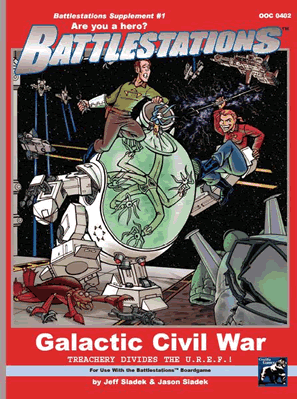
Battlestations Report: Galactic Civil War & miniatures
Gameday: Second attempt at BATTLESTATIONS
GameDay: Battlestations
A gent named Curufea (real name: Peter Cobcroft) has come up with what I think might be one of the definitive fansites out there, a wiki he owns and maintains. It has loads of useful infomration.
Check it out!
http://www.curufea.com/Wikka/wikka.php?wakka=GamesBattlestations
Curufea (who published a variant for the Le Grand Cirque game I designed) is trying to be a completist with this wikki thing; there's a lot of information packed away in a tidy wikki format. Recommended.
6:45 AM
.. because I think your career is heading for palookaville
LOS ANGELES // Michael Richards said Monday he spewed racial epithets during a stand-up comedy routine because he lost his cool while being heckled and not because he's a bigot.
Read the rest of the story at THE BALTIMORE SUN.
So it's clear to me that he kinda, sorta meant it when he blew his stack like that. That wasn't an act. I feel pity for him, but I do think he deserves magically becoming unhireable from now on.
See how quickly Seinfeld and Julia Louis Dreyfus will be to distance themselves from this (of course, they have careers),...
6:32 AM
Click on the flash object. Draw a line from top left to bottom right. Then press play...
11:33 PM
Adult Content Warning
The following video is of Michael "Kramer" Richards spouting a racist tirade at some comedy club in Los Angeles today. The language is quite offensive. I'm posting this because I can't figure if he was trying (and failing miserably) to channel Lenny Bruce's act fifty years after the fact (in which case he is just trying to shock the audience through the use of the word "nigger"), or maybe he really does think of black people this way. It's hard to say from the invective. He really does seem angry to me.
11:16 PM
I hadn't thought about these...

Until Porochik (see "The White General" in my blogrolling list) mentioned them for a possible new troop for the Xmas game. It's a good idea, and I can put together a nice troop of them for about 24 bucks and shipping.
Funny thing, I remember looking at these and thinking.. WHY are we doing wooden soldiers out of metal again??
I'm still in somewhat of a quandry about what rules to use. I did a Christmas variant of The Rules with No Name for last year, but it had a lot of flaws.
Maybe Chain Reaction?
12:45 PM
Here we are:
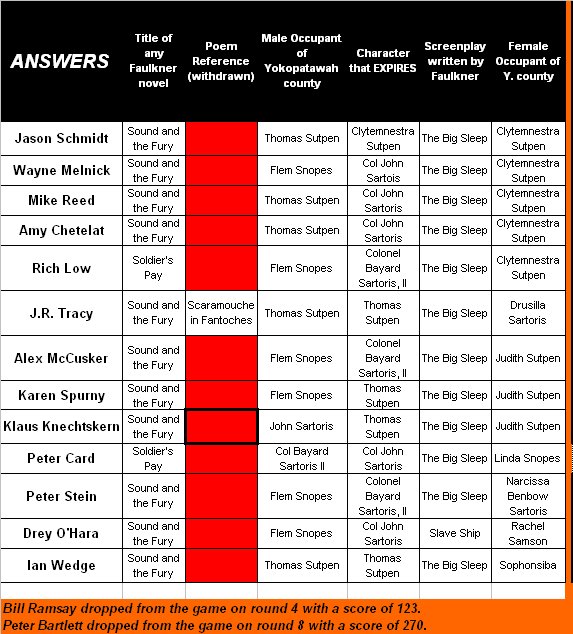
I didn't count the poetry category against anyone, but J.R. actually went to great lengths to answer with a bona fide response, so I rule he gets five points bonus for the effort.
I have to apologize for that category. For some reason, I recalled reading a book of literary criticism on Faulkner years back, and it cited his early work in poetry and gave examples. I didn't research it online very much, thinking the book was sufficient bona fides.
Fortunately I DID know about the "Faulkner on the Web" website out there that pretty much gave a breakdown of every citizen of Yokopatawah Country, and much of the rest of the round was based upon the index of characters I found there (except for the screenplay, which turned out to be a convenient "gimme" for almost all of you).
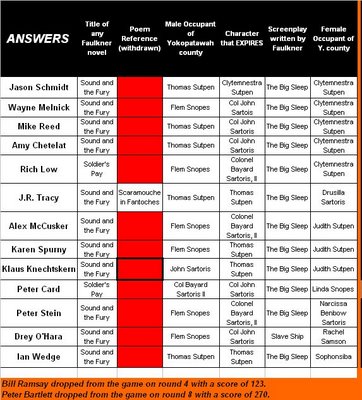
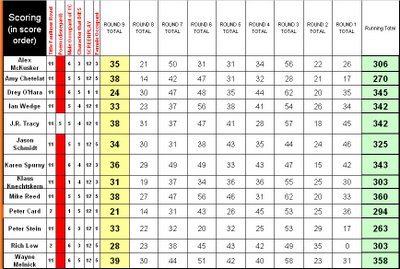
I didn't count the poetry category against anyone, but J.R. actually went to great lengths to answer with a bona fide response, so I rule he gets five points bonus for the effort.
I have to apologize for that category. For some reason, I recalled reading a book of literary criticism on Faulkner years back, and it cited his early work in poetry and gave examples. I didn't research it online very much, thinking the book was sufficient bona fides.
Fortunately I DID know about the "Faulkner on the Web" website out there that pretty much gave a breakdown of every citizen of Yokopatawah Country, and much of the rest of the round was based upon the index of characters I found there (except for the screenplay, which turned out to be a convenient "gimme" for almost all of you).
9:49 AM
Keep up the great work, Kimberly!

One of the things I'll miss in this new job I'm going to is seeing the new VRE garage going up. Considering how much time, money and effort it has taken us to get here, it's ironic that I'll never use the thing. Who knows? Never say never.
In any event, on those days that I catch the late train, I've noticed a rather pleasant lady quietly photographing construction progress. Seems like she's doing it every day I bump into her. So one day I made a "Dear Blog..." joke with her, to find out that yes indeed, she IS blogging construction progress right HERE. Good on ya, Kimberly, and keep up the great work. I'll enjoy viewing the garage go up by proxy during the upcoming year, and I'm adding your page to my Blogroll.
NOTE: the URL has changed. See this post.
6:55 AM
While waiting for Wayne and Audrey to acknowledge Round 9, we might as well start the more prompt people on Round 10.
Celebrating that quintessential man of letters, MARK TWAIN aka Samuel Clemens.

The secret letter is H
Categories:
1. A place where Twain resided
2. A literary influence for Twain
3. A Male Character with a name other than "Huckelberry"
4. A Female Character
5. A Love Interest (and there are a few)
6. A Real Life person who had an impact on Twain's Life, not mentioned already in your choices
Have fun! Standard disclaimers about first and last letters apply.
BPD 2, the Final Chapter
Celebrating that quintessential man of letters, MARK TWAIN aka Samuel Clemens.
The secret letter is H
Categories:
1. A place where Twain resided
2. A literary influence for Twain
3. A Male Character with a name other than "Huckelberry"
4. A Female Character
5. A Love Interest (and there are a few)
6. A Real Life person who had an impact on Twain's Life, not mentioned already in your choices
Have fun! Standard disclaimers about first and last letters apply.
1:06 AM
Nanofictionary

Here's what was seen:
Otto plays: CHARACTER: The Superhero with Unhelpful Powers
J.R. Discards three and gets three
Allan: plays a CHARACTER: The Pizza Delivery Guy
Jason: plays a CHARACTER: The Time Traveling visitor from 1888
The Discard Pile now holds:
SETTINGS:
Underground Secret Hideout
Polynesian Tiki Lounge
Dangerous Objects Factory
PROBLEMS:
Bungled Robbery Attempt
Terrible Storm
Who Ate My Brownies?
CHARACTERS:
Household of Three
Alien Disguised as a Human
The Millionaire
The Dude who always says "Dude"
Mischevious Children
RESOLUTIONS:
They were given a handsome Reward..
Nobody has played an Action Card yet.
Nobody has submitted a story yet.
Please start Card Phase 4; I have already heard from Jason.
10:51 PM
Fun with Flashbacks

Spoilers
A pretty good (not mindboggling great, but good) episode last Friday. The crew of the Galactica discover a burning Cylon Raider on the run from two other Cylon Raiders. The two raiders get smoked and the smoking raider gets escorted onto the Galactica.
Out of the raider drops a human pilot named Lt. Daniel "Bulldog" Novacek, who once served under Adama. He disappeared from sight 3 years previous, during a secret mission at Adama's behest. when Adama was at the helm of another Battlestar named Valkyrie (the third one seen on the new show!).
It turns out that "Bulldog" appears to be exactly what he says he is, genetically (and not a brand new form of Cylon). Which leads to a lot of flashbacks from all parties-- in which we see that Adama senior was once very highly regarded in the fleet, and that his post prior to the Galactica was a bit of a plum-- the Valkyrie being in the same class as Pegasus (apparently). Furthermore we also learn that because of events that transpire with Bulldog as the focal point, Adama was in something like a career exile on the Galactica. There's some serious soul-searching that goes on with all concerned.
The denouement is somewhat anticlimatic, and I don't need to go into it. I'm glad they introduced a new character and I hope he becomes a regular (frankly, the cast is a tad lilly-white in my opinion).
The Cylons were pretty confusing in this episode.. the D'Anna model (Lucy Lawless) has most of the screen time, with Baltar having no speaking lines at all and Caprica 6 only 2 or 3 lines. D'Anna has become somewhat taken with Baltar, if the evidence of a threesome with Caprica and Baltar is any clue (and thank you, Ms. Lawless, for the wonderful walkaway right after that scene.. you are a work of art!). I actually think the "D'Anna's nightmares" subplot seems to be pointless meandering, but you never know with Ron Moore. Everything connects.
In sum, a good not great episode, with some high points. Keep showing us the cylon point of view, Ron Moore! That's what is making this show great.
5:40 PM

A pleasant evening of chili and boardgames
I unexpectantly had an evening free last night, and rather than veg out or do something productive, I headed over to Hard Times Cafe in Springfield for dinner (and the OSU/Michigan game) and to hop over to gaming night at NoVa Comics. The crowd there (with Bill Edlard being the alpha male organizer type) is quite friendly and quite dedicated to getting in a lot of playing time. I recommend this group if you are in town or live around here-- they can be found here.

First on my list was LINE OF BATTLE, a game I'm reviewing for Paper Wars. It turned out to be a fun time-- I would rate it somewhere between the Admiralty triology and the GWAS series. I took a deliberate intro setup of two French battleships plus a small contigent of light cruisers and destroyers meeting a very similar German force in the Indian Ocean. The game mechanics are pretty straightforward, I thought, with the cheerful recommendation of "Ignore this when you play the first time" or "this is entirely optional", etc. So we played our first game with simple movement and initiative rules, no plotting and no advanced command rules. This was just to get the movement and firing mechanism down pat.
I probably came off as high-handed, walking in and setting up a game on one of the three tabeles, because the Saturday crowd is very Euro-centric. Fortunately David Hemingway, a guy I had bumped into just last week on the VRE train home, also stopped in on a miraculous night off, and he likes wargames. He took the Germans and I took the French. Immediately, I could tell that the designer probably took some broad shortcuts in his gunfire models, as the French and Germans were about equal even though their ships' guns were not. The only firing mod that came into play was crew quality which did impact things (you can imagine who had a below average crew). I thought that the designer (steven newberg) was concentrating on long range gunfire with this design, so I ended up acting pretty ahistorically with my little Gallic fleet, charging in to fire torpedos with my DDs and getting shot to pieces for my pains. The proper thing to do in game terms would have been to stand off and fire at the extreme range but that was too slow for me. So, David didn't have to work very hard.. I got a butt whomping, but I got to see how some of the key mechanics work, too.

The other game I played was NEXUS OPS, Avalon Hill's science fiction explore, exploit and exterminate game with big dayglo critters! You play the role of a mercenary captain trying to ruthlessly exploit a newly discovered planet with a mix of alien (and human) citters. The game has a nice mixture of design elements that are complimentary to each other-- hidden mission cards that grant you 1, 2, or 3 victory points if you fulfill the mission on them, plus regular battle cards that grant you 1 point of victory plus "Energizer" cards you get in defeat that give me bonuses. The objective is to control mines that give you more money that buy more units to blabh blah blab blah...
I won this handily, but to be fair, it's not the game it could be with only two players. I think it needs the full complement of 4 to play as designed.
So a pretty decent night of fun was to be had...
10:41 AM

Yes, it's a real product, one you can find on x-tremegeek.com
Do you long for the days when a phone handset was comfortable, hefty and tough enough to be slammed onto the receiver when being solicited by telemarketers? Our retro handset brings back those good ol' days and looks cool too! In a world of small-and-getting-smaller-cellphones, this retro handset converts your tiny phone into a beefy, comfortable retro phone! 2.5mm jack works with most phones (Motorola, LG, Samsung); not compatible with RAZR or Nokia phones. Cell phone not included.
Unfortunately, it's incompatible with my phone, but I won't have that phone forever, either...
1:45 PM
Wowsa
Follow Up from: Dear Santa...
Mighty Mack (Duncan Macdonald) and I broke out the USB Missile Shooter this morning...

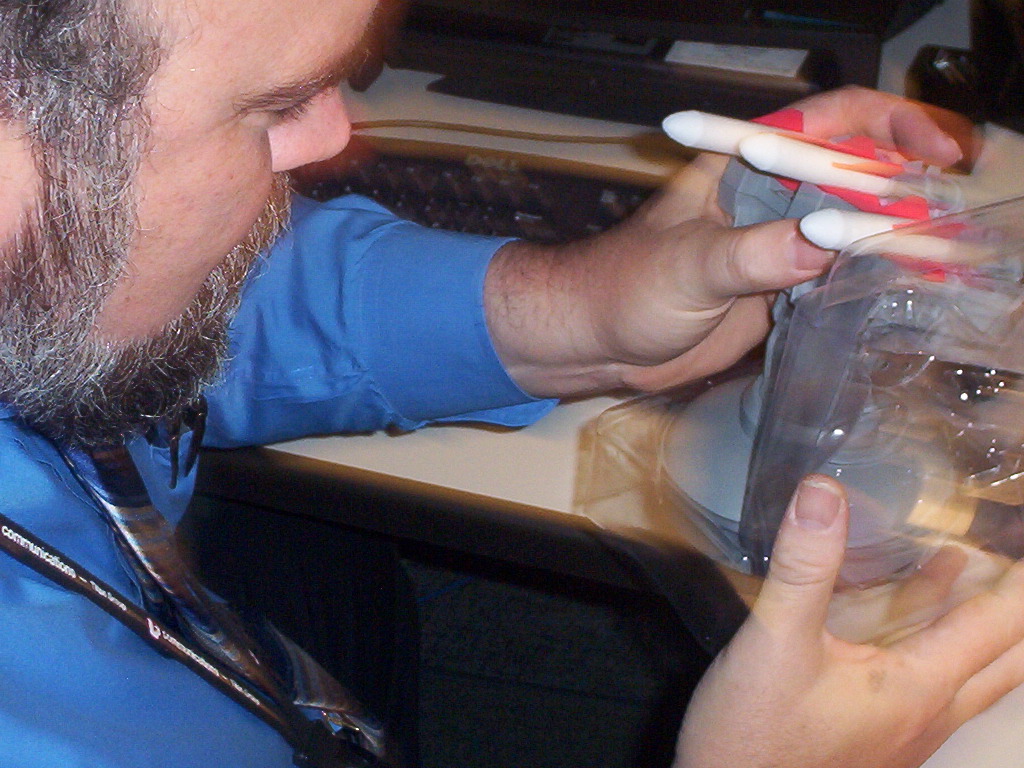
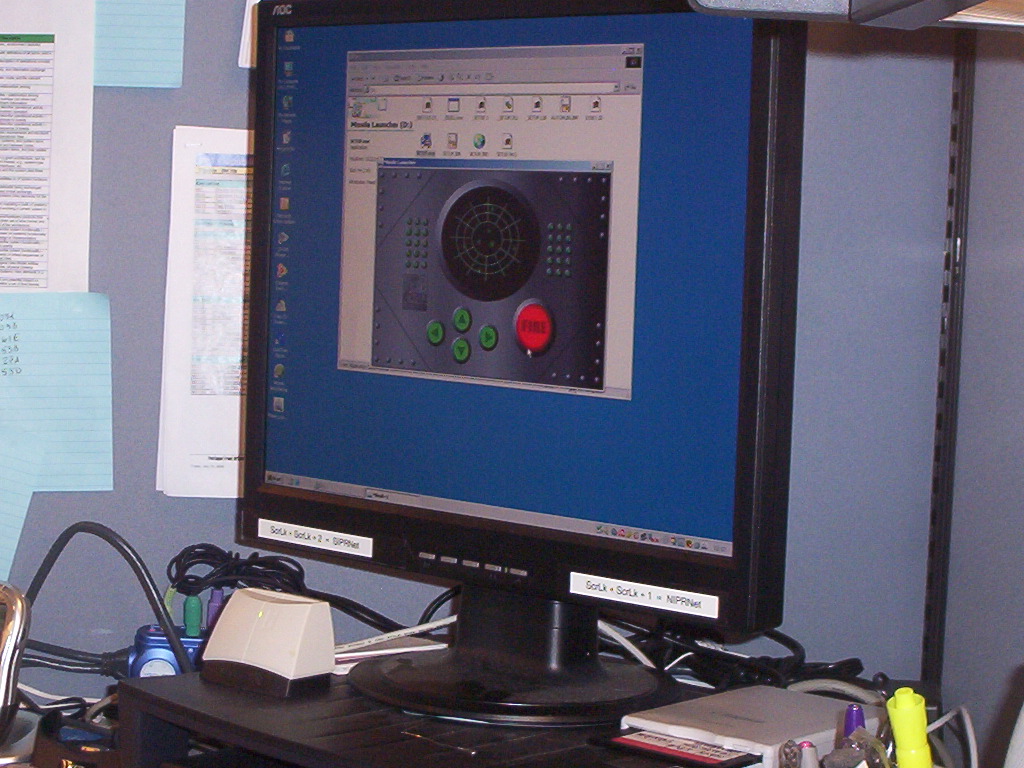


In sum, a great little "cube war" toy.. a little pricey but you can get it for cheap at Office Depot. Jeff bought it from ThinkGeek.com
1:12 PM
The Christmas game is not, and should NOT BE... Politically Correct...
I run the Christmas game for my game club TNGG, every December. Last December, I ran this:
http://mrnizz.blogspot.com/2005/12/aar-dark-secret-of-santa-town.html
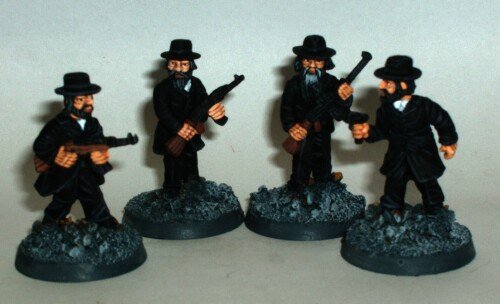
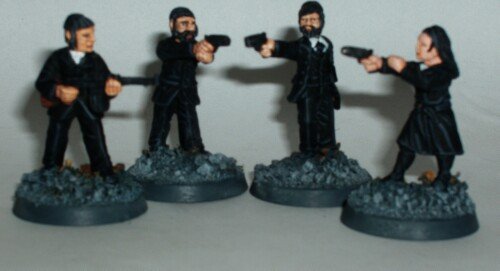
I just discovered (to my own surprise and glee) two new groups of hassidic "men in black" agents for sale at Amazon Miniatures. Naturally I bought them-- I had to. I certainly hope than when I add them into this year's Christmas Scenario "The Battle of the (toy) Factories" as the "Purim Gang", people won't get too offended...
6:36 AM
My Shopping Haul
All things being equal, I think I got away light. It's almost bad form to NOT mention what you spent money on, so here goes:
From Lon Weiss at Brigade Games:
Some discounted Shadowforge female gunfighter figures (and maybe a naughty nun or two, you never know when that will come in handy). Four singles and a three pack. For use in Wild West and VSF games.
In the Flea Market:
I got some large scale grotesque monsters for a 54mm Wizards game I'm contemplating. From a series called DREAMBLADE by the WotC.


 Also Age of Rifles (again) on CD (never can have enough copies), and a couple of interesting post-apocolyptic figures.
From Bob Bowling at RLBPS:

Copplestones - Xmas2 and Xmas1 (Father Christmas and Evil Snowmen) for our TNGG annual Christmas game, and FW36, because they are so cool.
From Wargames Inc of Tridelphia, WV:
The latest WARGAMES ILLUSTRATED and 1 15mm South African armored vehicle from QRF (for my AK 47 force I'm building) and 1 hovels 15mm structure for various games.
From the HOBBY BUNKER:
Four packs of AK47 figs from Peter Pig: 37, 119, 41, and 24 (for AK47) and 1 box Strelets WWI era Cossacks in 20mm (plastic) for Red Actions! Russo Polish War project.
From Jeff Hobbs' booth, several dice, punch drill and bits.
From Paroom Station aka Bob Charette: Theodore Roosevelt, A masked Minion with diaobolical weapon, a Landships crew, and a smiling anarchist.

From the Book guy in the center, another copy of the Ospery books on Russian Civil War, red armies.
That should cover it!


